


Reliability and resilience are critical for the warfighter, particularly in the unforgiving undersea environment. That is why startups, primes, and integrators are rapidly innovating on vehicle concepts and mission systems. One area where that innovation is lacking is propulsion and fin actuation, which often remain built from commercial off-the-shelf (COTS) components. While COTS products can offer benefits, they often do so at the expense of performance. Part of the reason why companies often rely on under-performing COTS solutions is that the majority of effort is placed in technological development of the fore-body of the vehicle, driven by the widespread view that the real value sits in sensors and software, while propulsion and actuation are often considered afterthoughts. That mindset drives teams to accept COTS trade-offs rather than invest in higher-performance hardware that could reduce long-term risk and cost.
At the same time, the Navy’s effector inventory presents a clear opportunity where power, propulsion, and actuation performance align with mission needs and are more than an afterthought. Many torpedoes and undersea effectors were designed in a modular fashion due to the nature of how the systems are constructed and ultimately integrated. The modular construction provides an opportunity to repurpose these systems, which are often propelled by internal combustion engines, with electric propulsion and fin actuation kits. This convertibility would allow re-use of components already in inventory, reducing overall cost and providing new functionality.
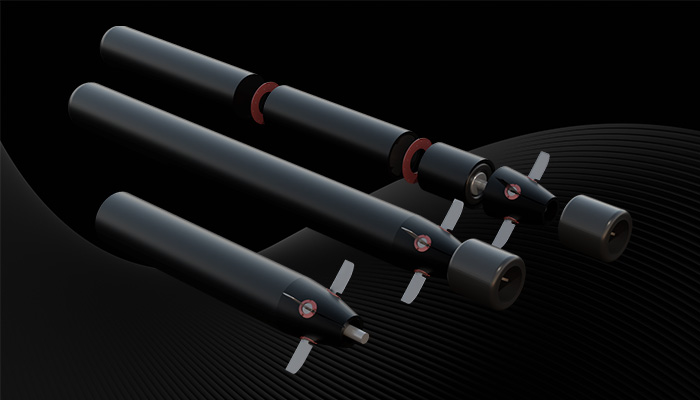
To answer that need, Moog is developing a modular electrification and afterbody kit that delivers greater capability than the COTS components currently used across industry, while meeting military environmental and performance requirements. By providing a modular energy storage, propulsion, and fin actuation set across the common vehicle sizes, our solution reduces non-recurring engineering associated with bespoke propulsion and actuation systems and enables reuse across commercial and defense UUV and torpedo markets, which in turn lowers lifecycle costs. This solution is called Maelstrom™.
Maelstrom emphasizes high power-density motors manufacturable with conventional processes, more power-dense energy storage, and common interfaces that consider both analog (for backwards compatibility) and digital control architectures.
“Maelstrom will provide a cost-effective modular solution that will accelerate development and reduce procurement timelines for the UUV and Undersea Warfare Markets. The design intent is to allow propulsion and energy storage to be iterated independently of vehicle development, so teams can upgrade power systems as technologies improve without redesigning vehicle architectures” said Tim Abbott, Business Development Manager for Moog Naval Systems.
The kit strategically targets common vehicle diameters, 21", 12.75", 6.75", and 4.875", and supports multiple configurations for each size, such as high-speed short-duration and low-speed long-endurance profiles, with either deployable or fixed fin options. That flexibility makes it possible to repurpose legacy torpedoes and UUV’s for new missions, reduces qualification risk, and shortens development timelines for both industry and the Navy. In practice, having a modular, qualified energy storage, propulsion, and fin control platform means industry can focus engineering resources on novel vehicle and payload functions instead of reinventing baseline propulsion for each program.
Moog is already furthering this technology with internal investments: three motor technologies are in development at TRL 3–5, and a 6.75” fin-deploy afterbody functional prototype was developed in 2024. These efforts are intended to accelerate development and create rapidly deployable technologies for Navy use.
In short, the Maelstrom modular electrification kits offer a pragmatic path to higher capability and lower cost in the undersea domain: they enable rapid re-purposing of inventory and reduce bespoke engineering and qualification risk.
For the warfighter, modular readiness translates into faster deployment of proven capabilities at sea, enhancing survivability and mission success. Ultimately, Maelstrom connects technology investments to mission successes and outcomes that keep operators ahead of evolving threats.

