


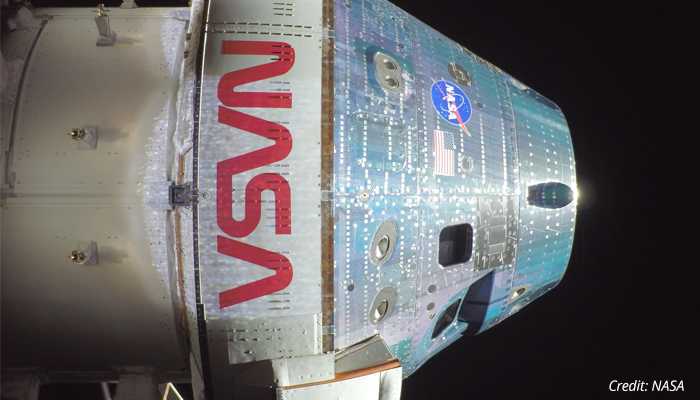
Space is unforgiving. Every breath, every degree of temperature, every drop of fluid must be carefully managed to keep astronauts alive.
“The space environment is one of the hardest environments to operate in,” said Dan Wilson, Moog Fluid Controls Engineering Director. “You have extreme temperatures, high radiation, and hard vacuums, and the technology we produce has to work in all possible combinations of those scenarios.”
Moog technology is not only responsible for the physical life support systems on Artemis’ Orion crew capsule but also the communications lifeline back to Earth, which is critically important on this record-setting mission 250,000 miles from home.
“The distance matters. Time on orbit matters. Everything must work for weeks or months, however long the mission is. Failure is not an option,” said Kevin Neff, Moog Fluid Controls Engineering Manager.
Artemis II was the first test of the Orion crew capsule with Astronauts at the helm, as well as the maiden voyage for many new technologies from Moog. Artemis II successfully proved out these systems to set the stage for Artemis III, which will be the first lunar landing in more than 50 years.
Creating a Safe Environment for Astronauts
As NASA’s Artemis program advances humanity’s return to deep space, the Orion crew capsule is a cornerstone of the mission. Orion must function as a safe, self-contained spacecraft capable of sustaining life and maintaining constant communication across vast distances.
“We're good at doing things that are hard. We like these challenges,” said Emily Grant, Moog Senior Product Engineering Manager.
Environmental Control and Life Support Systems (ECLSS) hardware from Moog ensured the Orion crew capsule remained a safe, habitable environment for the Artemis II astronauts who traveled further into space than any crew before and returned through Earth’s atmosphere safely at a speed of greater than 25,000 miles per hour.
“The technology we need to make this mission successful is very difficult to produce. We do the harder things to solve our customer's most difficult challenges,” said Wilson. “There are not a lot of places in the US, much less of world, that are capable of doing this.”
These precision-control components are part of system-level solutions that help regulate breathing gases and airflow, cabin pressure and temperature, and on-board fluid recycling and waste management. These systems work together to create a stable, livable environment in Orion from launch through re-entry.
“ECLSS components were a new product line for us as a company. We started with clean sheet designs. We tested everything, updated, prototyped, and eventually came up with a final product that we're delivering today,” said Grant.
These innovative systems are built on decades of proven Moog performance in chemical propulsion and cryogenic fluid controls that have enabled missions to every planet in the solar system.
“Heritage will get your foot in the door. But innovation is what keeps it there. We will take a design that has been successful and qualified and then modify it to add features to meet a specific need,” said Craig Owczarzak, Moog Fluid Controls Staff Program Manager.
Orion’s life support systems must operate flawlessly in extreme conditions, enduring intense vibration during launch, prolonged exposure to radiation, and the thermal swings of deep space.
“There's a lot of preparation, design work, analysis, a lot of testing. We have special processes for human-rated applications to ensure the safety of the crew and success of the mission,” said Neff.
Hundreds of Moog employees have ensured the success of this mission.
“We have the top skilled assembly technicians putting these components together, testing them, and fully vetting them out. There is a lot of pride throughout Moog because most people here have had some Artemis touchpoint,” said Grant.
Keeping the Crew Connected
Beyond the physical life support systems, the Orion communication system is the crew’s lifeline to keep astronauts in constant contact with mission control.
“Our contributions help ensure data and voice communications remain dependable across the vast distances of deep space,” said Phil Tokeshi, Moog Avionics Business Development Manager.
That uninterrupted connection enables real-time decision-making, situational awareness, and coordination throughout every phase of the mission. A Moog ethernet switch supports the reliable transfer of commands, telemetry, and crew communications between the spacecraft and mission control.
“It is very similar to the Wi-Fi systems at home and work,” said Tokeshi. “It could be electronic data transfer. It could be things that you're doing on your computer that need to connect to other pieces of equipment. There could be voice communication. It's all of that.”
While Artemis II is also the first voyage for the Layer 2 Ethernet switch, it is built on decades of Moog radiation-hardened avionics experience, with a variety of successful deep space and lunar missions.

Inspiring the Next Generation
“Very early in my career at Moog, I worked on the Moog actuators steering the rocket. Then I had the opportunity to support the development of the helium pressurization system for Orion. Now I serve as a program manager helping shepherd new development programs through completion for a bunch of different systems on Orion. When you're a little kid, you dream about this kind of stuff,” said Owczarzak.
“I recently had the opportunity to go to my children's school, and they were really interested in space and the hardware I showed them. One thing that surprised me was that when I showed them a model of the Space Shuttle, they didn't really know what it was. Shuttle was something that was such a huge inspiration for me choosing this career path. Artemis is such a great opportunity for us to reinvigorate our youth’s interest in space, understand why it's important, and to see how much it can really impact the country and our development of the sciences.”
Enabling the Next Giant Leap
Artemis II was an important milestone in NASA's goal of returning humans to the lunar surface.
“There’s a lot of pride in seeing Artemis launch and getting astronauts back to the Moon for the first time in 50 years. I'm old enough to remember part of the Apollo missions. I never thought it would happen again. For me personally, to see that happen again and be a part of it is, is something very special,” said Tokeshi.
Space will always be unforgiving, but with innovation, precision, and unwavering commitment to reliability, Moog is helping turn the impossible into reality, one mission at a time.

