


Supporting NASA launches since 1968, from Apollo to Artemis
3/31/2026
Interested in speaking with Moog?
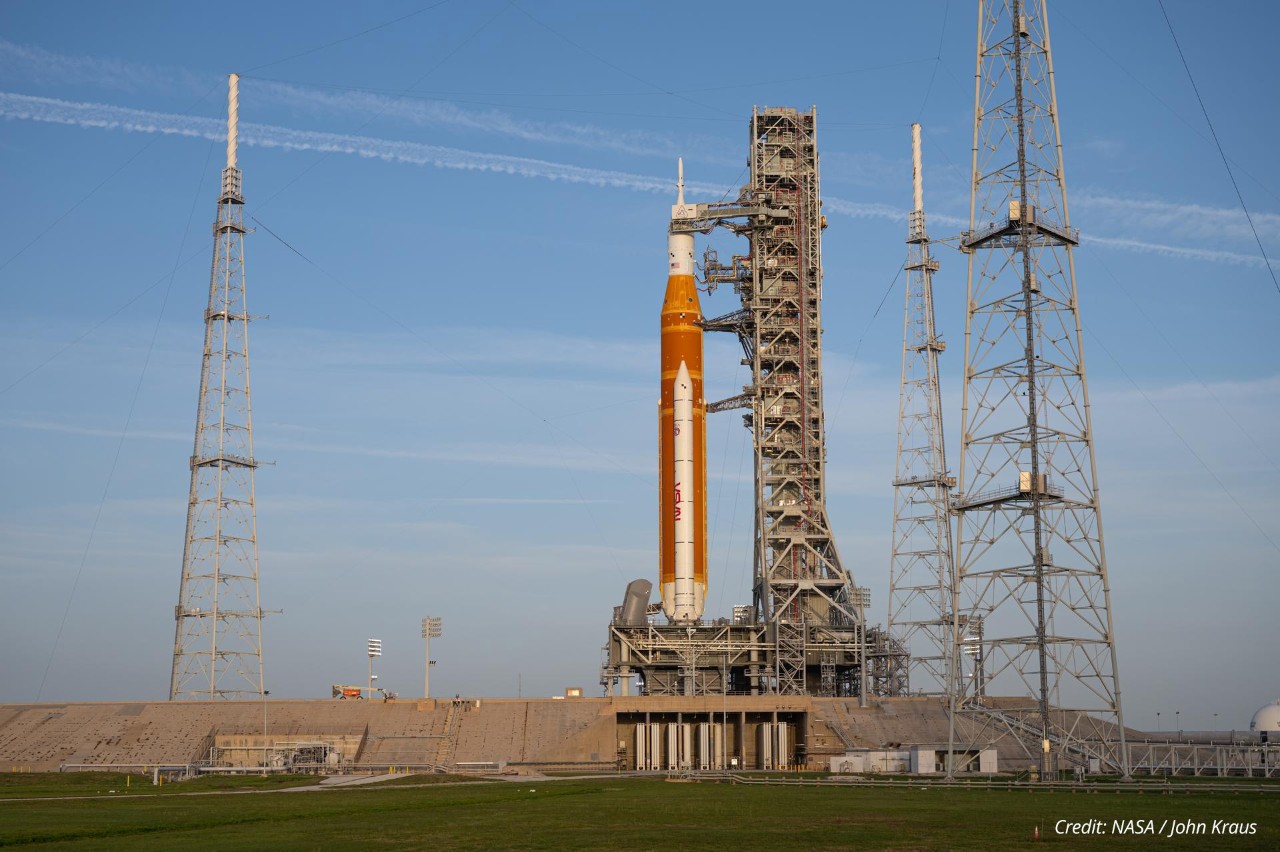
Moog has supported U.S. launch infrastructure since the earliest days of human spaceflight. Among our longest serving systems are the gantry actuators installed on NASA Kennedy Space Center’s Mobile Launch Platform. These actuators drive the split-second retraction of the swing arms, critical interfaces that connect the rocket to the mobile launch pad to supply power, propellants, purge lines, and crew access.
These actuators have been in continuous operation for every mission off the mobile launch pad from Apollo to today’s Artemis missions. Their flawless performance over more than six decades reflects engineering focused on reliability, harsh environment durability, and long-term maintainability.
“The Moog actuators are critical to the liftoff, the final gantry movement at the T minus zero moment in the countdown. This means the movement is initiated at the same time as the liftoff thrust is being fully generated, so any failure by the actuator to retract could be catastrophic to the vehicle,” said Allen Ruef, Moog Business Development Manager.
What Are Gantry Actuators?
Gantry actuators are high-torque electrohydraulic systems that control the movement of the launch pad’s swing arms during the countdown and up to the final moments of launch. Each actuator must meet strict requirements for:
• Rapid response — completing full arm rotation in under one second
• Repeatable accuracy — ensuring correct arm alignment and clearances
• High load tolerance — managing static arm weight plus dynamic loads from wind and pad vibration
• Environmental robustness — enduring coastal humidity, corrosion, thermal cycling, and acoustic pressure during launch
Moog’s actuators carry out this work with precision and speed, ensuring every critical connection disengages safely and smoothly.
What Happens During Launch?
In the final moments before liftoff, six swing arms must retract from the rocket in a precise sequence. At the top, the crew access arm swings away without time pressure, but as you move down the rocket, gantries retract at specific countdown points, such as T-20 or T-10. The most critical movements occur at T-4 and T-0, when the bottom arms swing back in under one second. These rapid motions prevent interference with the rocket as it begins to ascend.
To achieve this speed, Moog’s actuators rely on high hydraulic flows, moving hundreds of gallons of fluid under extreme pressure. This generates quick acceleration and deceleration, creating intense jolts at start and stop points. Actuators and structural components are engineered to withstand these forces while maintaining precise control.
Failure to retract or an unexpected rebound could damage the rocket and jeopardize the mission, making these systems mission critical.

Engineering That Endures
Moog’s gantry actuators were installed in the 1960s to support the Apollo program, including Apollo 11—the first human mission to the Moon. Engineered to withstand Florida’s coastal climate, intense vibrations, and extreme launch conditions, their consistent performance helped establish Moog as a trusted spaceflight partner.
While NASA’s programs have evolved, Moog’s gantry actuators have remained a constant. That have supported more than 100 launches, and before each launch, NASA requires 100 tests of the gantry retraction. Their longevity through thousands of these dramatic movements reflects the strength of their robust design, precision control, and proven reliability.
“In the last 20 or so years, only two have come back for service,” said Reuf. “And when they do, the service is a complete teardown. The main housing is one large casting, so we remove inner linings, replace wear items, fasteners, and seals. Everything is inspected, repainted, and then retested to ensure full functionality,” said Ruef.
Looking Ahead
As Moog expands its work across aerospace and defense systems and next-generation space technologies, our heritage at Kennedy Space Center continues to serve as a reminder of the possibilities durable engineering brings to spaceflight innovation.
The gantry actuators at Launch Complex 39 are more than mechanical assemblies. They represent Moog’s commitment to reliability, thoughtful design, and mission success. But they also symbolize something bigger: the engineering that drives innovation in a rapidly evolving space industry. As commercial launches, lunar missions, and deep-space exploration accelerate, Moog’s proven expertise in high-performance motion control continues to set the standard for what’s possible.

