


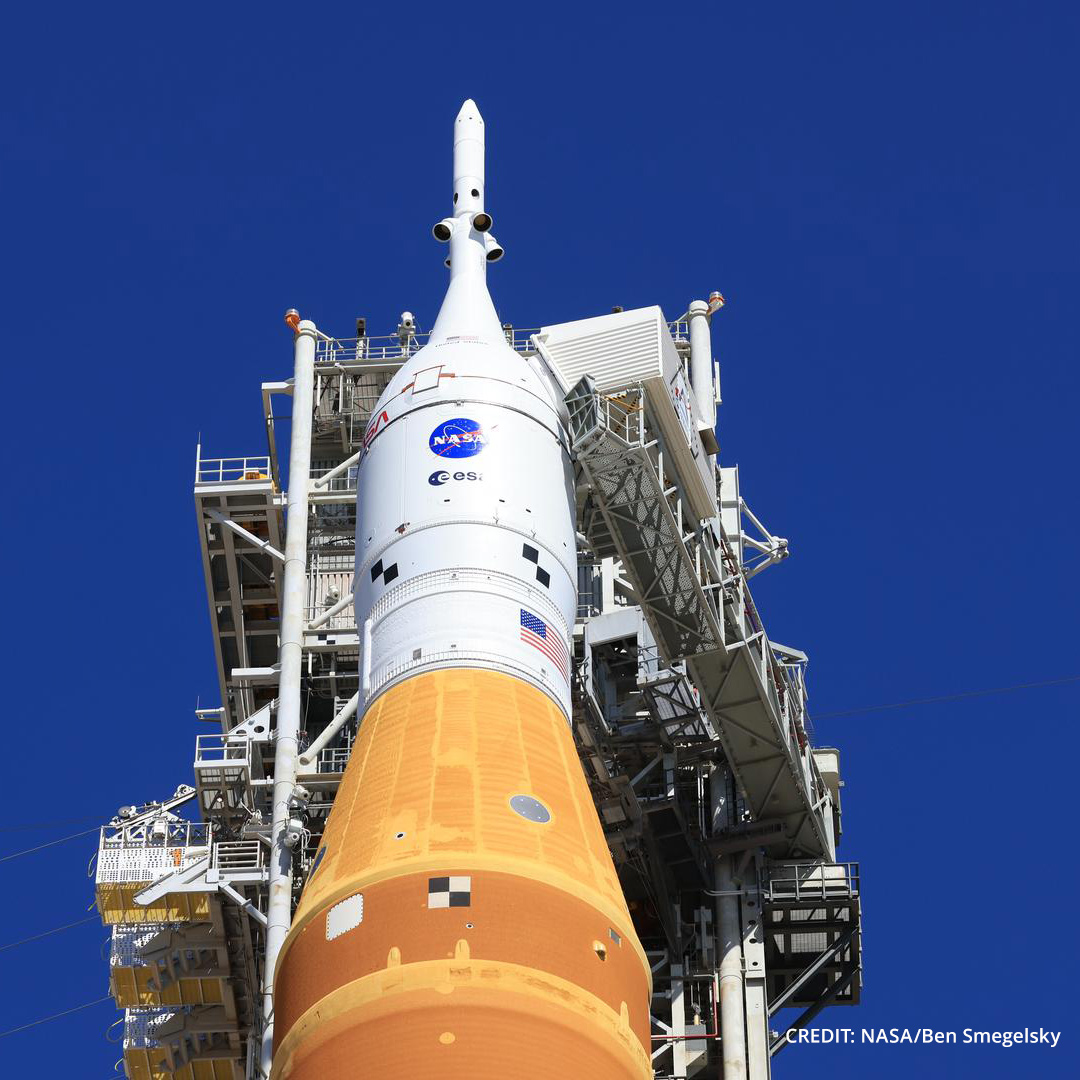
Artemis II represents a bold step forward, sending humans further into space than any mission before and laying the groundwork for the first crewed Moon landing in more than 50 years. At the core of this mission is a remarkable blend of engineering and human courage.
Among the many critical systems on board, one exists for a moment no one ever hopes to see. The Orion Launch Abort System (LAS) is designed to keep astronauts safe if there is an emergency during launch, and Moog technology plays a pivotal role in making it work.
“It's both an honor and also a really important responsibility,” said Nicole Wodka-Cook, Moog Actuation and Avionics General Manager.
What is the Launch Abort System?
Sitting atop NASA’s Space Launch System (SLS) rocket, the Launch Abort System is a tower‑like structure packed with solid rocket motors engineered to pull the crew capsule away from the SLS rocket if something goes wrong during launch.
The LAS includes three solid rocket motors:
Abort Motor: Pulls the crew module away from the launch vehicle.
Attitude Control Motor: Steers and orients the capsule during escape.
Jettison Motor: Separates the LAS from the crew module before parachute deployment.
“Together, these motors ensure that astronauts can be safely extracted from danger in a matter of milliseconds. These are incredibly precise and important,” said Alex Bergmann, Moog Product Engineering Manager.
Moog's Contribution
In the event of an emergency, raw thrust alone isn’t enough to get astronauts to safety.
“Moog worked on the attitude control motor, which defines the direction the crew capsule will go once it is separated from the main rocket,” said Ralph Rietz, Senior Project Engineer.
In an abort scenario, the LAS must keep Orion stable as it separates from the rocket with extreme force and acceleration.
“The system's working in milliseconds. An automatic command is sent to the Launch Abort System to jettison and control the crew capsule. It's an incredibly high rate of speed at which the astronauts are jettisoned. We wouldn't want somebody to manually steer their way through that. Everything's automatically controlled,” said Bergmann.
Eight Moog actuators positioned at the top of the abort tower receive commands to precisely regulate the thrust of eight independent nozzles simultaneously. That ensures the crew capsule remains correctly oriented throughout the abort trajectory.
“The launch abort system actuators pintle in and out to control valves that steer the crew module and the launch abort tower, away from any sort of disaster scenario,” said Bergmann.
Moog’s actuation systems are engineered for this kind of mission‑critical reliability. Our flight‑control technologies, including thrust vector control actuation systems, steer many launch programs, including the SLS rocket. These components must perform flawlessly under extreme conditions like high vibration, rapid acceleration, and intense heat.
“There have been a lot of innovations for this system coupled with the proven Moog heritage on missions since the beginning of spaceflight. Our hardware is critical to the success of these missions and getting astronauts to the Moon and back to Earth safely, and we take that responsibility very seriously,” said Rietz.
Bergmann added, “This is something incredibly personal to me and that I am incredibly proud of. I worked on these during my first year at Moog and have continued to work on them for the last several years.”
In all, more than 500 Moog employees across the country are contributing to the Artemis missions.
“This starts with our supply chain team. We have to procure parts. We have technicians that assemble those parts. We have amazing engineers that help us through technical challenges, and our quality team ensures flawless performance and quality. We have a whole cross-functional team that supports this incredible mission. They're all extremely skilled and talented at what they do,” said Wodka-Cook.

Prepared for a Moment That May Never Come
Though the Launch Abort System may never need to be activated, it must be ready to work perfectly in an instant. The systems have built in redundancies and are rigorously tested to ensure they respond immediately, reliably, and predictably under every condition.
“We try to simulate almost every scenario that these actuators could see during a launch. We are testing thermal, vibration, shock, and more, ensuring that if they are needed, that they will absolutely work,” said Bergmann.
Moog actuation technologies are at the heart of systems that keep astronauts safe. Artemis II marks our return to deep space human exploration. And thanks to the dedication of engineers, designers, technicians, and innovators, the mission will carry not only our ambitions—but also the highest levels of safety and engineering excellence—into the next era of exploration.

