


The drone threat requires a modular, layered response
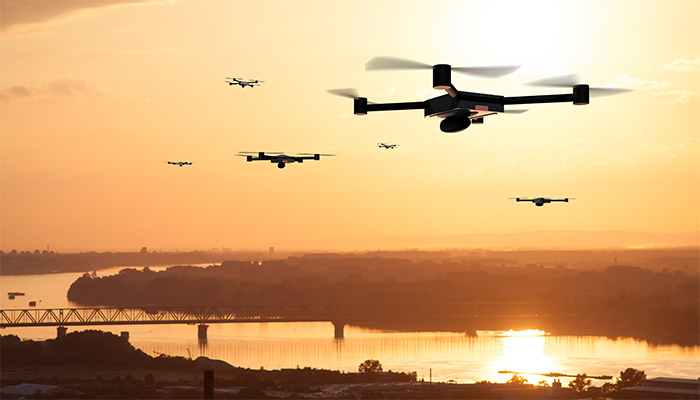
The character of modern warfare is fundamentally changing. What began as a niche capability reserved for advanced militaries rapidly become a ubiquitous, low cost tool leveraged by state and non state actors alike. Today’s battlefield demonstrates a clear reality: drones are no longer an auxiliary capability; they are a primary threat vector, regardless of whether they are commercial quadcopters or highly capable long-range solutions.
This evolution of unmanned aerial systems (UAS) is not a temporary disruption but a structural shift in how threats are fielded and how defenses must respond. Flexibility is key as new drone tactics emerge on almost a weekly basis.
“In modern conflicts, success is not determined by defeating a single drone. It is defined by sustaining protection against dozens or hundreds over time,” said Paul Stoelting, Moog Engineering Director. “Solutions must be affordable enough to deploy broadly, modular enough to adapt quickly, and simple enough to support in austere environments.”

Why Drones Are Such a Persistent Problem
The challenge of drones is not just their presence. It is their accessibility, adaptability, and scale.
Commercial-off-the-shelf components and open-source software have dramatically lowered the barriers to entry. Adversaries can now field surveillance drones, loitering munitions, and coordinated swarms at a fraction of the cost of traditional weapon systems. These platforms are increasingly expendable, networked, and rapidly iterated, allowing tactics to evolve faster than legacy defenses.
Despite significant investment, many current counter UAS (C-UAS) solutions remain mismatched to the threat:
- Dozens of drones with dynamic flight paths for multi-angle attacks complicate traditional air defense radar detection and defense.
- Drones challenge cost asymmetry, forcing defenders to consider whether it makes sense to defeat a $5,000 threat with a $500,000 interceptor. Because of the affordability at scale, the adversary can continue launching drones until the defender is out of exquisite solutions with which to respond. These high-end solutions alone cannot economically counter mass UAS attacks.
- UAS can be launched anywhere, reducing warning time and increasing risk to fixed and mobile assets
Furthermore, while promising C-UAS concepts exist, too few have been ruggedized, integrated, and live fire tested against these swarm-type threats. The result is a persistent, distributed modern threat that demands equally flexible countermeasures. That is why the modern warfighter needs modular, cost-effective solutions that provide persistent protection against the most common threats, while preserving higher end interceptors for when they are truly needed.
Moog’s Approach: Proven Systems, Evolving Capability
“Countering drones isn’t about finding a silver‑bullet technology,” said Marco Racheli, Business Development Engineer. “Success depends on adaptable, cost‑effective systems that can scale appropriately to the threat and the environment they’re defending.”
Moog’s Reconfigurable Integrated weapons Platform (RIwP®) and Lightweight RIwP® (LW RIwP) are examples of this philosophy in practice. These systems provide stabilized, modular weapon platforms that support multiple effectors and sensors, enabling customers to tailor solutions to mission needs, whether mounted on tactical vehicles, naval platforms, or fixed sites. Moog’s standard RIwP is the centerpiece for the Army’ s fielded Air Defense/C-UAS programs of record SGT Stout and MLIDS on armored Stryker-based platforms to address Group 3 and larger UAS threats along with rotary and fixed wing aircraft. Just as importantly, our RIwP platform is combat proven and production ready, offering a mature foundation for C-UAS integration rather than experimental prototypes.
Beyond today’s fielded systems, Moog continues to invest in developing technologies explicitly designed to counter emerging drone threats. These solutions promise expansive fire power to reduce cost-per engagement, modularity and scalability for rapid deployment, and 360° accurate positioning for better tracking of modern threats. These capabilities are not confined to the laboratory; they are being integrated, hardened, and live fired. Moog is developing future turreted weapon systems with LW RIwP on Moog’s Reconfigurable Self-Loading Equipment Dock (MR SLED) to support the light vehicle and robotic platforms for M-SHORAD Inc 4 to address Group 1-3 UAS and rotary and fixed wing aircraft. Additional new solutions that have had successful live fires in 2026, with further tests scheduled for later this year, include LW RIwP, VengeanceTM, and Flexible Mission Platform (FMPTM). Vengeance is a remotely operated, modular counter-UAS rapid-development platform and technology demonstrator. It is built on the FMP and Weapon Stores Management System (SWS) to enable rapid integration, data fusion, and evaluation of a wide spectrum of sensors, kinetic and electronic-warfare effectors, and advanced fire-control solutions.
“Our disciplined and collaborative approach with various partners ensures that innovation translates into deployable, systems at speed,” said Stoelting.
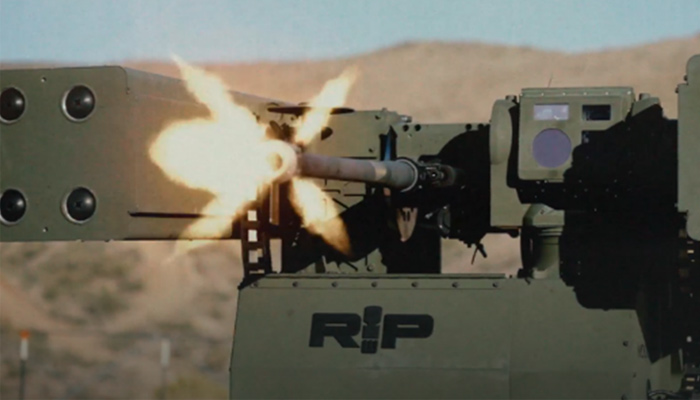
Moog RIwP
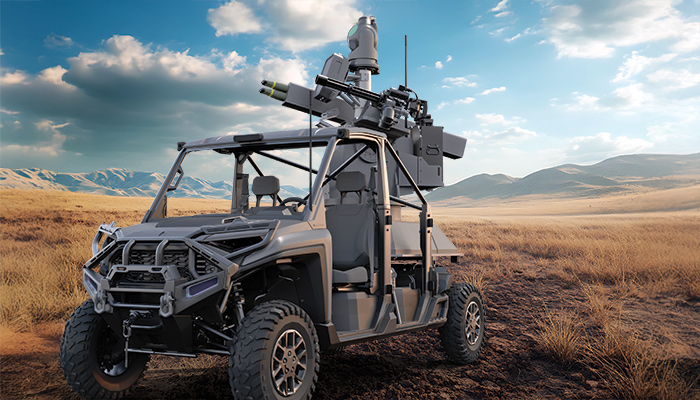
Moog Vengeance
Looking Ahead
Moog’s role is not to promote a single answer to the C-UAS challenge, but to provide resilient, layered, and affordable architectures that warfighters can trust. By combining Moog’s field-proven solutions with forward leaning investment in next generation technologies, we help close the gap between today’s threats and tomorrow’s defenses.
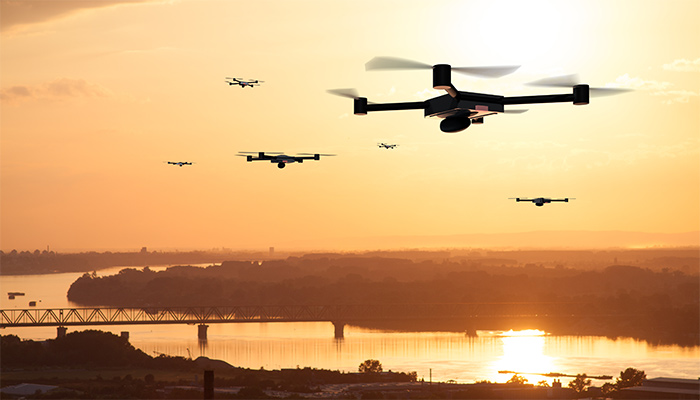
The drone threat will not plateau. It will continue to diversify in form, frequency, and sophistication. C-UAS solutions must evolve just as quickly without sacrificing affordability, reliability, or readiness.
Moog remains committed to partnering with our customers and end-users to meet this challenge head on. Not with promises, but with proven systems, disciplined innovation, and a clear understanding of what modern warfare demands.
Because in today’s unmanned and AI-powered battlespace, adaptability is not optional.
