



As NASA prepares for its next crewed mission to the Moon, Moog continues in powering exploration. Since the inception of spaceflight, Moog has been a trusted partner, providing the precision motion control technologies that help spacecraft launch, maneuver, and return safely.
Artemis II: A Mission of Firsts
Artemis II marks the first crewed flight of NASA’s Artemis program and represents a defining moment in the return of humans to the Moon. The four person crew will travel farther into space than any astronaut has gone before, venturing more than 1,200 miles past the previous distance record set during Apollo. Their journey will take them roughly 409,000 miles from Earth as they orbit the Moon and test critical systems needed for future landing missions. The flight will also be the first time in more than 50 years that humans leave Earth’s orbit.
This mission is defined by international partnership. The European Space Agency provided the Orion Service Module, which supplies propulsion, power, and life support throughout the deep space journey. This marks the first time a crewed lunar spacecraft will rely on a major component system built by a non U.S. space agency, demonstrating the global nature of exploration and setting the stage for broader cooperation across Artemis missions building off the strong relationship built during the International Space Station.
A Crew That Will Make History
The Artemis II astronauts represent a new era of exploration and a series of historic firsts. The crew will include the first woman, the first person of color, and the first non American to travel beyond Earth’s orbit.
Artemis II will also be the first crewed lunar mission to carry four astronauts at once. Earlier Apollo spacecraft accommodated three, meaning this new generation of crew vehicles must support greater complexity in life support systems, avionics, propulsion, and redundancy. The mission will expand NASA’s understanding of how modern spacecraft perform during long duration deep space operations, with innovative Moog technologies helping Orion spacecraft throughout its historic journey.
Moog’s Contributions to Artemis and Beyond
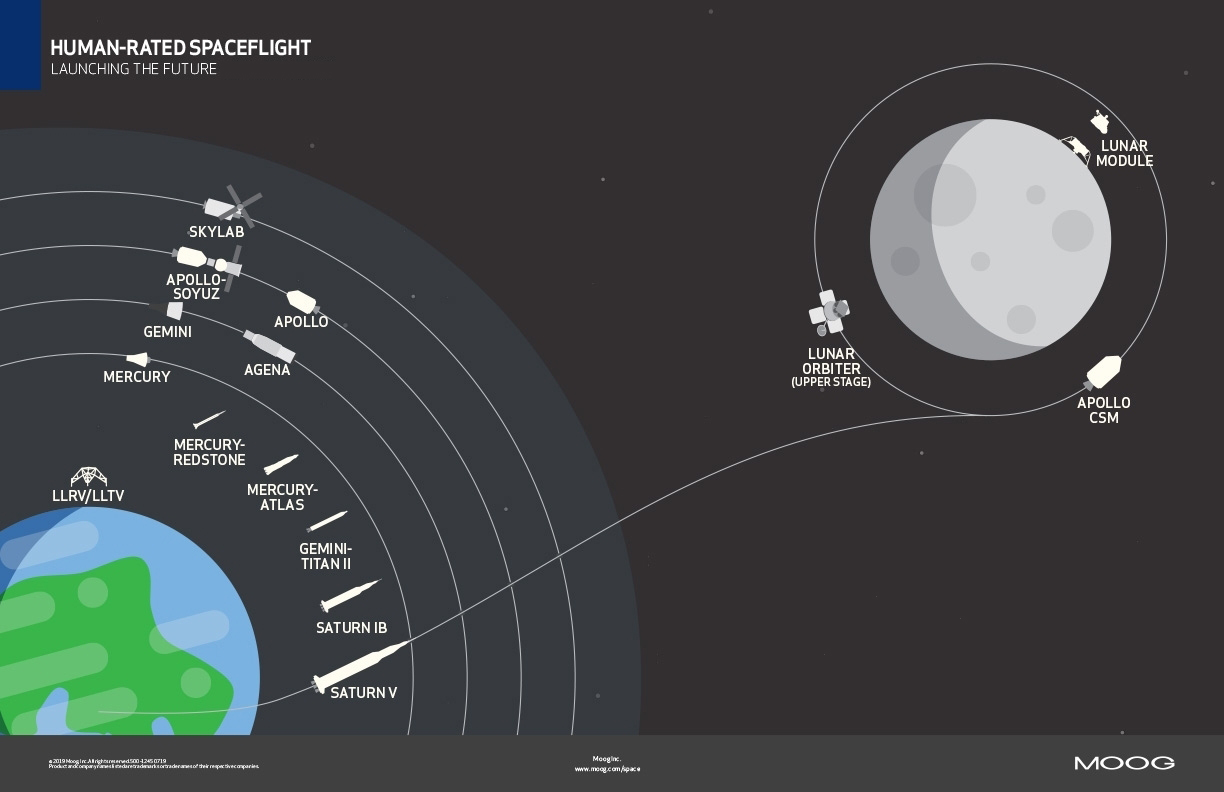
The company’s involvement in exploration began well before Apollo, and has continued through the Space Shuttle Program, the International Space Station, and robotic missions to other planets. This enduring presence reflects a commitment to innovation, reliability, and mission success, forming the foundation on which modern exploration programs are built.
“Behind every launch, landing, and deep space maneuver are Moog employees whose dedication makes exploration possible.” Said Steve Witkowski, Director Space Actuation & Avionics
Artemis I launched in 2022 with Moog hardware supporting all aspects of the mission. On the Core Stage Moog provided thrust vector control actuators and controllers. The solid rocket motors, carried over from the shuttle era, used Moog actuators and Moog valves. The Interim Cryogenic propulsion module also used Moog thrust vector control as well as Moog valves for the cryogenic fuel and oxidizer. The crew module had propellant valves for the helium system. Finally, the tip of the rocket, the launch abort system uses Moog actuators to control the solid rocket motors that would safely pull the crew from the rocket if there was an issue during launch.
Moog’s impact to exploration extends beyond the Moon, sending spacecraft on missions to every planet in our solar system. During NASA’s Perseverance Rover mission, Moog actuators and thrusters guided the launch vehicle and deep space cruise to Mars, respectively and its Moog throttle valve assemblies controlled the entry spacecraft’s engines during its descent to the Martian surface.
As Artemis II prepares to launch, Moog’s precision motion control expertise once again plays a pivotal role. Through decades of continued investment in engineering, manufacturing, and testing, Moog provides innovative components and systems designed to operate flawlessly in extreme environments. The company supports technologies essential to propulsion system performance, guidance and navigation, actuation, life support, and spacecraft maneuvering, capabilities that ensure Orion can safely execute the mission’s demanding deep space flight profile. Moog engineers from across the country worked to modernize, simplify, and strengthen critical systems. This fusion of heritage and innovation enables Artemis vehicles to withstand radiation, vacuum, temperature fluctuations, and the intense vibration and forces associated with launch and re entry.
“Artemis represents the transition from proven capability on the ground to sustaining human presence beyond Earth orbit. Moog’s role is ensuring that every motion, adjustment, and maneuver performs exactly as intended, because at this stage of exploration, precision is what makes progress possible.” Said Steve McDonald- Staff Manager/ SDG Engineering

The Journey Ahead
The Artemis II mission is a critical steppingstone toward returning humans to the lunar surface and establishing a long term presence on and around the Moon. The crew’s journey will validate the systems needed for Artemis III, including deep space navigation, life support, propulsion, and the performance of the Orion spacecraft. It will also pave the way for lunar surface missions, new science opportunities, and the development of the technologies required for human missions to Mars.
A Legacy That Evolves with the Mission
From Apollo to Artemis, and from the first lunar footsteps to today’s next generation missions, Moog’s engineering heritage remains essential to expanding humanity’s reach into the solar system. As space becomes increasingly contested, commercialized, and interconnected with national security priorities, Moog is expanding its focus across defense and advanced aerospace systems.

